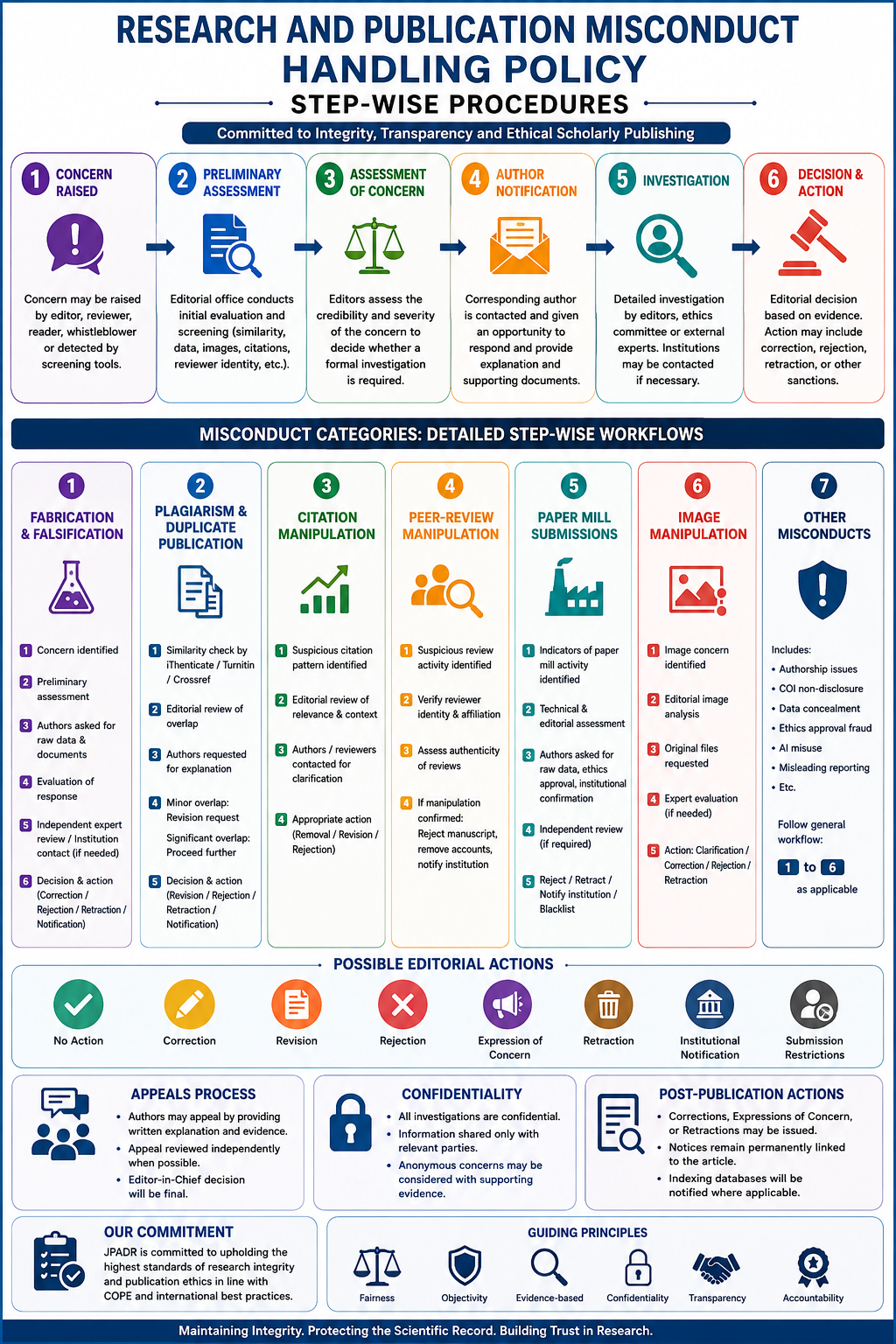
Research and Publication Misconduct Handling Policy
Research and Publication Misconduct Handling Policy
Policy and Workflow for Handling Research and Publication Misconduct
The Journal of Pharmacovigilance and Drug Research (JPADR) is committed to protecting the integrity, transparency, reliability, and ethical standards of scholarly publishing. The journal does not tolerate research misconduct, publication misconduct, or unethical publishing practices at any stage of the editorial or publication process.
JPADR follows the ethical guidance, flowcharts, and Core Practices of the Committee on Publication Ethics (COPE), together with internationally accepted standards for research integrity and responsible scholarly communication.
This policy outlines the journal's approach to:
- Identifying suspected research and publication misconduct.
- Conducting preliminary ethical assessments.
- Managing confidential investigations.
- Implementing fair editorial actions.
- Protecting the integrity of the scholarly record.
- Promoting transparency and responsible publishing practices.
1. Purpose of This Policy
This policy establishes standardized procedures for identifying, evaluating, investigating, and addressing suspected research or publication misconduct throughout the editorial and publication process.
The objectives of this policy are to:
- Identify suspected misconduct.
- Conduct preliminary assessments.
- Investigate ethical concerns objectively.
- Ensure fair and confidential handling.
- Protect scientific integrity.
- Apply appropriate editorial actions where necessary.
This policy applies to:
- Authors.
- Reviewers.
- Editors.
- Editorial Board Members.
- Submitted manuscripts.
- Published articles.
All investigations are conducted according to principles of fairness, proportionality, confidentiality, and evidence-based editorial decision-making.
2. Types of Misconduct Covered by This Policy
JPADR may investigate allegations or evidence relating to, but not limited to, the following forms of misconduct:
- Fabrication of data.
- Falsification of data.
- Plagiarism.
- Self-plagiarism.
- Duplicate publication.
- Citation manipulation.
- Peer-review manipulation.
- Authorship manipulation.
- Paper mill submissions.
- Image manipulation.
- Undisclosed conflicts of interest.
- Ethical approval fraud.
- Fake reviewer identities.
- Data concealment.
- Artificial intelligence misuse.
- Misleading reporting practices.
Additional concerns may also be investigated where they potentially compromise research integrity, publication ethics, or the reliability of the scholarly record.
3. General Principles for Misconduct Investigations
All investigations undertaken by JPADR are conducted according to internationally accepted ethical principles and publication integrity standards.
Investigations will follow these principles:
- Fairness.
- Confidentiality.
- Objectivity.
- Transparency.
- Evidence-based assessment.
- Protection against false allegations.
Throughout the investigation process, the journal will:
- Avoid premature accusations.
- Provide authors with an opportunity to respond.
- Maintain confidentiality whenever possible.
- Seek institutional involvement where appropriate.
Investigations may involve:
- Editors.
- Editorial Ethics Committee.
- Independent subject experts.
- Research institutions.
- Regulatory or oversight bodies where necessary.
4. Preliminary Assessment Workflow
When potential research or publication misconduct is identified, the Editorial Office conducts a preliminary assessment to determine whether sufficient evidence exists to justify a formal investigation.
The purpose of the preliminary assessment is to distinguish genuine ethical concerns from administrative errors, misunderstandings, or unsupported allegations while ensuring fair treatment of all parties.
Initial Screening May Include
- Similarity analysis.
- Data consistency review.
- Image integrity assessment.
- Reviewer identity verification.
- Citation pattern analysis.
- Editorial correspondence review.
- Submission history examination.
- Evaluation of supporting documentation.
Where concerns appear credible based on available evidence, the manuscript or published article may proceed to a formal editorial investigation.
Preliminary Assessment Workflow
| Step | Editorial Action |
|---|---|
| Step 1 | Potential misconduct concern received from editors, reviewers, readers, whistleblowers, or similarity screening. |
| Step 2 | Editorial Office conducts an initial evidence review. |
| Step 3 | Supporting documents and manuscript records are evaluated. |
| Step 4 | If concerns appear credible, a formal investigation is initiated. |
5. Fabrication and Falsification Policy
Definitions
Fabrication
Fabrication refers to making up research data, patient information, experiments, observations, or scientific findings that never actually occurred.
Falsification
Falsification refers to manipulating research materials, equipment, methodologies, images, analyses, or datasets in ways that misrepresent or distort research findings.
Indicators of Possible Fabrication or Falsification
- Improbable or inconsistent datasets.
- Statistical anomalies.
- Repeated data patterns.
- Contradictory methodology descriptions.
- Missing or unavailable raw data.
- Unrealistic participant recruitment timelines.
- Suspicious graphs, charts, or figures.
- Internal inconsistencies between reported results and methods.
Investigation Workflow for Fabrication and Falsification
| Step | Editorial Process |
|---|---|
| Step 1 | Concern identified by an editor, reviewer, reader, whistleblower, or other credible source. |
| Step 2 | Editorial Office performs a preliminary assessment of available evidence. |
| Step 3 | Authors are contacted and requested to provide supporting documentation, including:
|
| Step 4 | The editorial team evaluates the authors' explanations and supporting evidence. |
| Step 5 | If concerns remain unresolved, independent expert review and institutional consultation may be initiated. |
| Step 6 | Possible editorial outcomes include:
|
Evidence of fabrication or falsification represents one of the most serious forms of research misconduct. Confirmed cases may result in manuscript rejection, article retraction, institutional notification, and additional editorial sanctions where appropriate.
6. Plagiarism and Duplicate Publication Workflow
JPADR screens all submitted manuscripts for plagiarism, text overlap, and redundant publication before peer review and may conduct additional assessments during editorial evaluation or after publication if concerns arise.
The journal may use recognized similarity detection tools, including:
- iThenticate.
- Turnitin.
- Crossref Similarity Check.
- Other recognized plagiarism detection software.
Similarity reports are interpreted carefully and contextually. Editorial decisions are based on the nature, extent, and significance of overlapping material rather than similarity percentages alone.
Investigation Workflow for Plagiarism
| Step | Editorial Process |
|---|---|
| Step 1 | Similarity concern identified during editorial screening, peer review, or post-publication assessment. |
| Step 2 | Editorial evaluation of the extent, source, and nature of overlapping material. |
| Step 3 | Authors are contacted and invited to provide an explanation or clarification. |
| Step 4 | Editorial assessment determines the appropriate course of action:
|
| Step 5 | Serious plagiarism cases may lead to:
|
Duplicate and Redundant Publication
JPADR discourages duplicate publication, redundant publication, and simultaneous submission of substantially similar manuscripts to multiple journals without appropriate disclosure.
Possible indicators include:
- Submission of substantially similar manuscripts.
- Re-publication of previously published findings without proper justification.
- Failure to disclose related publications.
- Duplicate datasets presented as new research.
- Fragmented or "salami" publication practices.
Authors are expected to disclose related manuscripts, conference abstracts, preprints, and previously published material during submission to facilitate transparent editorial evaluation.
7. Citation Manipulation Policy
JPADR prohibits unethical citation practices intended to artificially increase citation metrics, journal indicators, or individual author citation counts.
Citation Manipulation Includes
- Excessive self-citation.
- Insertion of irrelevant citations.
- Coercive citation requests.
- Citation cartels.
- Reciprocal citation agreements.
- Artificial inflation of journal impact indicators.
Editors, reviewers, and authors are expected to recommend citations solely on the basis of scientific relevance and scholarly value.
Investigation Workflow for Citation Manipulation
| Step | Editorial Process |
|---|---|
| Step 1 | Suspicious citation patterns are identified during editorial assessment or peer review. |
| Step 2 | The editorial team evaluates citation relevance, necessity, and contextual appropriateness. |
| Step 3 | Authors, reviewers, or editors may be contacted to explain unusual citation practices. |
| Step 4 | Editorial action may include:
|
8. Peer-Review Manipulation Policy
JPADR strictly prohibits any attempt to manipulate, compromise, or fraudulently influence the peer-review process.
Examples of Peer-Review Manipulation
- Fake reviewer identities.
- Fabricated reviewer email addresses.
- Reviewer impersonation.
- Coordinated peer-review fraud.
- Undisclosed reviewer conflicts of interest.
- Submission of fraudulent AI-generated peer reviews.
- Third-party interference with peer review.
Investigation Workflow for Peer-Review Manipulation
| Step | Editorial Process |
|---|---|
| Step 1 | Suspicious reviewer activity or irregular peer-review patterns are identified. |
| Step 2 | Reviewer identities, affiliations, and contact information are independently verified. |
| Step 3 | The authenticity and integrity of submitted peer-review reports are assessed. |
| Step 4 | If manipulation is confirmed, editorial action may include:
|
9. Paper Mill Detection and Handling Policy
JPADR does not accept manuscripts produced through unethical commercial paper mill operations or any services that fabricate, manipulate, or misrepresent scientific research.
The journal actively evaluates manuscripts for indicators that may suggest paper mill involvement or systematic publication misconduct.
Indicators of Possible Paper Mill Activity
- Highly similar manuscript structures across unrelated submissions.
- Recycled or duplicated figures, tables, or datasets.
- Suspicious or inconsistent authorship patterns.
- Template-based scientific writing.
- Methodological inconsistencies.
- Unverifiable institutional affiliations.
- Fabricated reviewer recommendations.
- Implausible submission histories.
- Evidence of third-party manuscript production services.
Paper Mill Investigation Workflow
| Step | Editorial Process |
|---|---|
| Step 1 | Editorial suspicion or a credible external allegation is received. |
| Step 2 | Technical, editorial, and similarity assessments are performed. |
| Step 3 | Authors may be requested to provide:
|
| Step 4 | Independent expert review or institutional consultation may be undertaken where appropriate. |
| Step 5 | Where concerns remain unresolved, editorial actions may include:
|
The journal reserves the right to request original research documentation whenever substantial concerns regarding manuscript authenticity or research integrity arise.
10. Image Manipulation Policy
JPADR prohibits deceptive image manipulation that alters, obscures, fabricates, or misrepresents scientific observations or research findings.
Unacceptable Image Practices
- Selective enhancement that changes scientific interpretation.
- Addition or removal of image features.
- Image duplication presented as separate experiments.
- Fabricated microscopy images.
- Manipulated radiographs, gels, or blots.
- Undisclosed AI-generated scientific images.
- Misleading image splicing or compositing.
Acceptable Image Adjustments
Minor image adjustments may be acceptable when applied uniformly to the entire image and when they do not alter the scientific meaning of the data.
Examples include:
- Brightness adjustment.
- Contrast adjustment.
- Cropping.
- Color balancing.
- Image resizing for publication.
Any image modification must preserve the accuracy, authenticity, and scientific interpretation of the original data.
Image Investigation Workflow
| Step | Editorial Process |
|---|---|
| Step 1 | Potential image concern identified by editors, reviewers, readers, or image screening. |
| Step 2 | Editorial image assessment is conducted using available technical methods. |
| Step 3 | Authors are requested to provide original, unprocessed image files and supporting documentation. |
| Step 4 | Independent image experts may be consulted where necessary. |
| Step 5 | Possible editorial outcomes include:
|
11. Confidentiality During Investigations
JPADR seeks to maintain confidentiality throughout misconduct investigations whenever possible and consistent with fair editorial practice.
Information related to investigations may be shared only with individuals or organizations that have a legitimate need to participate in the evaluation or resolution of the matter.
Information may be disclosed to:
- Relevant editors.
- Editorial Ethics Committee members.
- Independent experts.
- Research institutions.
- Funding agencies where appropriate.
- Regulatory authorities where legally or ethically required.
Anonymous whistleblower reports may be considered when supported by credible evidence and sufficient information to permit objective editorial evaluation.
Confidentiality Commitment
The journal strives to protect the identities, reputations, and procedural rights of all individuals involved during misconduct investigations while ensuring that editorial decisions are based on objective evidence and internationally accepted publication ethics standards.
The journal strives to protect the identities, reputations, and procedural rights of all individuals involved during misconduct investigations while ensuring that editorial decisions are based on objective evidence and internationally accepted publication ethics standards.
12. Editorial Actions and Sanctions
Following completion of an editorial investigation, JPADR may implement appropriate actions that are proportionate to the nature, severity, and evidence of the identified misconduct. Editorial actions are intended to protect the integrity of the scholarly record while ensuring fairness and due process.
Possible editorial actions include:
- No action where allegations are unsupported.
- Educational guidance or corrective advice.
- Requests for manuscript revision.
- Correction of published articles.
- Manuscript rejection.
- Expression of concern.
- Retraction of published articles.
- Removal of reviewers or editors from journal activities.
- Notification of relevant institutions or funding agencies.
- Temporary or permanent submission restrictions where appropriate.
Sanctions are determined according to:
- The seriousness of the misconduct.
- The quality and reliability of available evidence.
- The impact on the scientific record.
- The extent of author cooperation.
- Applicable ethical guidance and publication standards.
The journal seeks to ensure that editorial actions are fair, proportionate, transparent, and based upon objective evidence rather than assumptions or unsupported allegations.
13. Appeals Process
Authors who disagree with an editorial decision related to research or publication misconduct may submit a formal appeal for independent consideration.
Appeals should include:
- A detailed written explanation.
- Supporting evidence.
- Relevant clarification documents.
- Any additional information that may assist editorial evaluation.
Appeals will be reviewed independently whenever feasible by editorial personnel who were not directly involved in the original decision.
During appeal review, the journal may:
- Request additional documentation.
- Consult independent experts.
- Seek institutional clarification.
- Reassess available evidence.
Following completion of the appeal review, the Editor-in-Chief will communicate the final editorial decision. Decisions following the formal appeal process are considered final.
14. Post-Publication Actions
Where research or publication misconduct is identified after publication, JPADR may take appropriate corrective actions to preserve the integrity, accuracy, and transparency of the scholarly record.
Editorial actions may include:
- Publication of corrections.
- Expressions of concern.
- Article retractions.
- Metadata corrections.
- Notification of indexing and abstracting services.
- Communication with research institutions or funding organizations where appropriate.
Retraction notices, correction notices, and expressions of concern will remain permanently linked to the affected publication to maintain transparency and preserve the publication history.
Where appropriate, corrected metadata and updated article information may be communicated to relevant indexing services and digital repositories.
15. Cooperation with Institutions and Regulatory Bodies
JPADR recognizes that effective management of research misconduct often requires collaboration with relevant organizations responsible for research oversight and governance.
Where appropriate, the journal may cooperate with:
- Universities.
- Research institutions.
- Institutional ethics committees.
- Funding agencies.
- Regulatory authorities.
- Professional organizations.
Institutional investigations may proceed independently of journal investigations. Editorial decisions are made based on the available evidence and applicable publication ethics standards while respecting the responsibilities of external organizations.
The journal may provide relevant documentation to authorized institutions where legally or ethically appropriate and consistent with confidentiality obligations.
16. Commitment to Research Integrity
The Journal of Pharmacovigilance and Drug Research (JPADR) is committed to promoting the highest standards of research integrity, ethical scholarship, and responsible scholarly publishing throughout the editorial and publication process.
The journal supports:
- Ethical scholarship.
- Honest and accurate reporting of research.
- Transparent editorial and publication practices.
- Responsible peer review.
- Scientific accountability.
- Evidence-based editorial decision-making.
- Continuous improvement in publication ethics.
- Protection of the integrity of the scholarly record.
JPADR recognizes that maintaining trust in scientific communication requires collaboration among authors, reviewers, editors, publishers, research institutions, funding organizations, and readers. The journal therefore remains committed to fostering an ethical publishing environment based upon fairness, transparency, accountability, and internationally recognized publication ethics standards.
Research Integrity Commitment
JPADR remains dedicated to safeguarding the credibility of scientific research by preventing research misconduct, promoting ethical publication practices, ensuring transparent editorial oversight, and maintaining the integrity of the permanent scholarly record.
JPADR remains dedicated to safeguarding the credibility of scientific research by preventing research misconduct, promoting ethical publication practices, ensuring transparent editorial oversight, and maintaining the integrity of the permanent scholarly record.
References
- Committee on Publication Ethics (COPE). COPE Flowcharts and Core Practices.
- International Committee of Medical Journal Editors (ICMJE). Recommendations for the Conduct, Reporting, Editing, and Publication of Scholarly Work in Medical Journals.
- World Association of Medical Editors (WAME). Publication Ethics Policies and Best Practices.
Final Policy Declaration
The Journal of Pharmacovigilance and Drug Research (JPADR) affirms its commitment to investigating allegations of research and publication misconduct fairly, objectively, confidentially, and in accordance with internationally recognized publication ethics guidance. The journal is dedicated to protecting scientific integrity, promoting responsible scholarly communication, correcting the scholarly record where necessary, and maintaining public confidence in published research.
Journal of Pharmacovigilance and Drug Research (JPADR)
Research and Publication Misconduct Handling Policy
Prepared in accordance with internationally recognized principles of research integrity, publication ethics, editorial accountability, and responsible scholarly publishing.
This policy may be periodically reviewed and updated to reflect revisions in international publication ethics guidance, editorial best practices, and evolving standards for responsible scholarly communication.
© Journal of Pharmacovigilance and Drug Research (JPADR). All Rights Reserved.